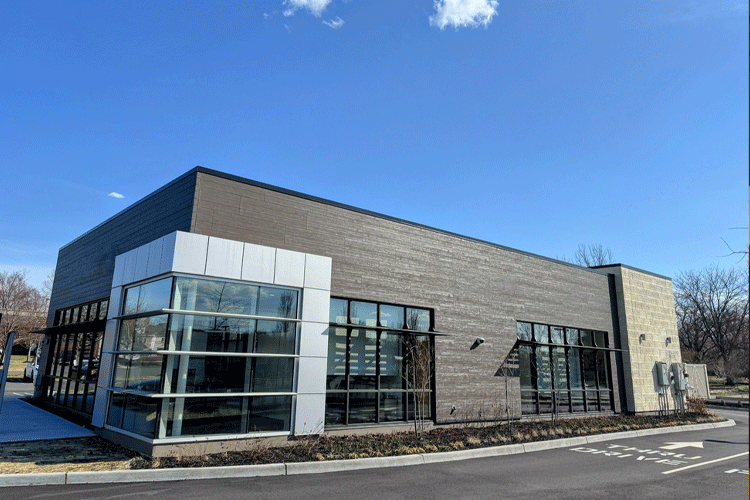
An aging commercial property does not always need to be replaced to become more functional, attractive, and valuable. Offices, retail centers, restaurants, medical facilities, hospitality properties, and other commercial buildings can often be repositioned through carefully planned improvements. A South Florida commercial property renovation can update an existing building while adapting it to changing tenant expectations, business operations, technology, accessibility, and long-term ownership goals.
Successful renovation, however, requires more than selecting new finishes. Existing buildings contain conditions and constraints that ground-up construction does not. Contractors must understand the current structure, building systems, layout, access, code requirements, permitting considerations, and how construction will affect occupants.
For owners and businesses, the most effective renovation projects begin by defining why the property needs to change and developing the construction scope around that objective.
Why Renovate an Existing Commercial Property?
Commercial buildings must evolve as businesses and markets change. A space designed decades ago may no longer support current workflows, customer expectations, equipment, technology, branding, or operational requirements.
Renovation allows owners to improve existing real estate rather than automatically pursuing new construction. Depending on the property, improvements may address appearance, functionality, interior layouts, building systems, customer-facing spaces, employee areas, or underutilized portions of the building.
A South Florida commercial property renovation can be particularly valuable when a property is well located but its physical space no longer reflects the needs of current tenants or users.
ECO Builders provides commercial construction services in South Florida for owners planning renovations, tenant improvements, new construction, and other property upgrades.
Start With the Building’s Existing Conditions
Before determining what a commercial property can become, the project team needs to understand what already exists.
Existing walls, structural components, electrical and mechanical systems, plumbing, entrances, ceilings, flooring, fire protection, accessibility conditions, and other building elements can influence the renovation.
Early evaluation helps identify potential conflicts between the desired design and the existing property. It can also reveal repairs that should be incorporated into the construction scope rather than discovered after work is underway.
For older properties, this step is particularly important because years of alterations may mean the building no longer corresponds perfectly with original drawings or previous assumptions.
Define the Business Objective Before the Construction Scope
A commercial renovation should solve a business or property problem.
Owners should begin by determining what the completed space needs to accomplish. A medical office may need a more efficient patient flow. A restaurant may need changes to dining, kitchen, or service areas. An office may need flexible workspaces and meeting rooms. A retail property may need improved customer circulation and a stronger storefront presence.
Important questions include:
- Who will use the renovated space?
- Which existing areas are no longer functional?
- Does the project need to accommodate new equipment or technology?
- Will the property remain occupied during construction?
- Are future tenants or business expansion part of the plan?
- What budget and completion date must the project support?
Answering these questions early creates a clearer basis for design, estimating, permitting, and construction.
Use Pre-Construction to Reduce Surprises
Pre-construction is one of the most valuable stages of a commercial renovation because decisions made before work begins can influence virtually every later phase.
During planning, the project team can review the proposed scope, existing conditions, preliminary costs, schedule, materials, constructability, and sequencing. Potential conflicts can be addressed while changes are still easier to make.
ECO Builders offers pre-construction and design-build services that coordinate planning, budgeting, design, permitting, and construction considerations before the project reaches the field.
Strong pre-construction planning helps transform a renovation concept into a buildable project.
Plan for Construction in an Occupied Building
One of the defining challenges of a South Florida commercial property renovation is that the business or neighboring tenants may need to continue operating.
Construction activity can affect entrances, hallways, parking, utilities, customer access, deliveries, noise levels, and employee work areas. The project plan should determine which portions of the building can remain active and how construction areas will be separated.
Phasing is often useful for occupied properties. Instead of renovating the entire facility simultaneously, work can be divided into sections or scheduled around operating requirements.
Communication between the owner, contractor, property management, tenants, and other stakeholders becomes especially important when construction and normal operations share the same property.
Consider Tenant Improvements as Part of the Renovation
Commercial renovation and tenant improvement projects frequently overlap. A building owner may renovate common areas and exterior elements while an individual tenant requires a customized interior build-out.
Tenant improvements can transform an existing commercial shell or previously occupied suite into a space designed around a specific business. That may involve new partitions, finishes, ceilings, flooring, lighting, electrical work, plumbing modifications, or other improvements depending on the project.
ECO Builders provides commercial renovations and tenant improvements in Miami-Dade County, along with construction services throughout South Florida.
Coordinating owner improvements and tenant work can help prevent duplicated construction and scheduling conflicts.
Do Not Ignore the Building Exterior and Structure
Interior renovation can dramatically improve a commercial property, but owners should also consider the condition of the building envelope and structural components.
A modernized interior does not resolve deteriorated concrete, recurring moisture intrusion, failed exterior coatings, damaged decks, or other existing building concerns.
When deterioration is present, renovation planning may need to incorporate commercial concrete restoration alongside interior improvements.
This broader approach can be particularly important for South Florida properties exposed to humidity, rainfall, coastal conditions, and long-term weathering.
Prioritize Improvements That Support Long-Term Use
Renovation budgets are rarely unlimited, so owners should prioritize improvements according to the property’s objectives.
A practical hierarchy may include:
- Necessary repairs and building-condition issues
- Code, accessibility, and life-safety related work identified for the project
- Operational improvements that make the space function better
- Mechanical, electrical, plumbing, or technology upgrades required by the new use
- Customer and employee areas that influence everyday experience
- Finishes, branding, and aesthetic improvements
The exact priorities will vary, but separating essential improvements from optional upgrades can help owners make more informed decisions when evaluating the construction budget.
Commercial Renovation Can Reposition an Existing Asset
A renovation can do more than make a building look newer. It can reposition a commercial property for a different tenant profile, modernize an outdated business environment, improve space utilization, or prepare a property for its next phase of ownership.
That is why the project should be evaluated from both a construction and business perspective.
The best South Florida commercial property renovation strategy connects design and construction decisions to the property’s long-term purpose.
An owner planning to hold a building for many years may prioritize durability and flexibility. An investor preparing a property for leasing may emphasize marketability and adaptable tenant spaces. An owner-occupant may focus more heavily on workflow and customer experience.
Understanding that objective helps guide decisions throughout construction.
Choose an Experienced South Florida Commercial Contractor
Commercial renovation requires coordination across planning, demolition, construction, building systems, inspections, finishes, scheduling, and project management. Existing conditions can introduce challenges that are difficult to predict without experience working in occupied and previously constructed environments.
The contractor should understand how to organize these moving parts while maintaining communication with the owner and other project stakeholders.
ECO Builders Provides Commercial Renovation Expertise Across South Florida
ECO Builders Inc. provides commercial construction, commercial renovations, tenant improvements, concrete restoration, new construction, and pre-construction services across South Florida. The company’s experience spans offices, retail environments, hospitality properties, healthcare facilities, industrial buildings, and other commercial spaces.
For a South Florida commercial property renovation, ECO Builders can help guide the project from early planning and scope development through construction and completion. By combining renovation expertise with broader commercial construction and restoration capabilities, ECO Builders provides property owners with an experienced team capable of addressing both the visible transformation of a building and the construction requirements behind it.
Frequently Asked Questions
What should be evaluated before renovating a commercial building?
Owners should consider the existing building condition, intended use, structural and building systems, required improvements, budget, permitting, accessibility, schedule, and whether the property will remain occupied during construction.
How long does a commercial property renovation usually take?
The timeline varies according to project size, design complexity, permitting, material availability, existing conditions, inspections, and whether work must be phased around an operating business.
Can a commercial building remain open during renovation?
In many cases, construction can be phased so portions of a property remain operational. Whether that is practical depends on the scope, safety requirements, utilities, access, noise, and how construction affects employees, customers, or tenants.
What is the difference between a commercial renovation and a tenant improvement?
A commercial renovation can involve broader improvements to an existing property, while tenant improvements typically customize a particular leased or occupied space for the needs of a specific business. A project can include both.